
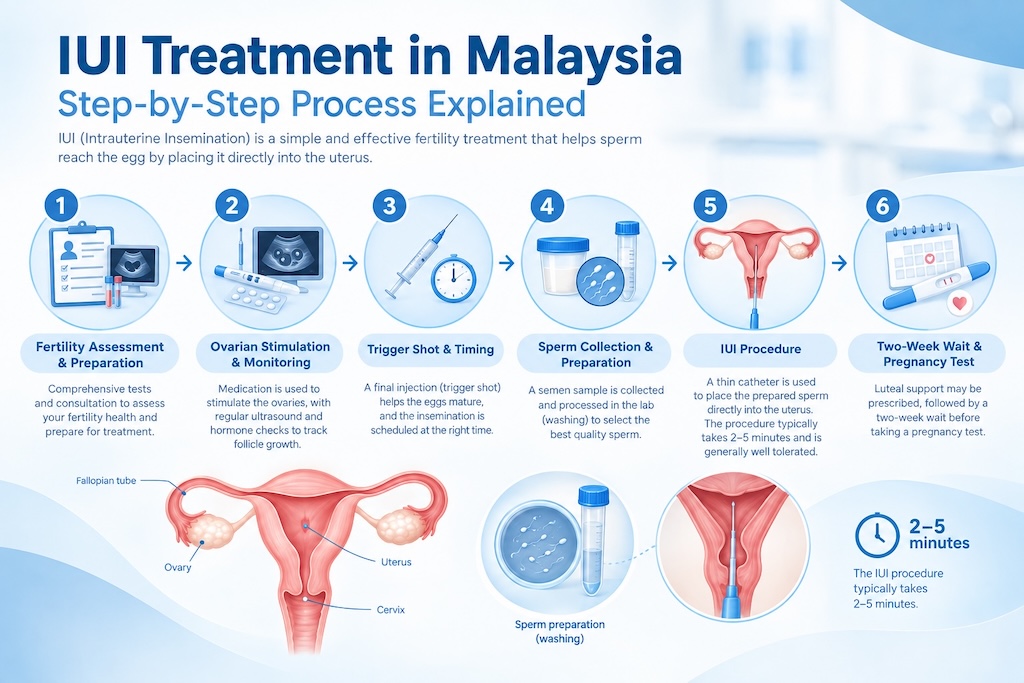
Intrauterine Insemination (IUI) is one of the most common first-line fertility treatments recommended at fertility clinics in Malaysia. Often referred to as artificial insemination, IUI is a minimally invasive procedure that places prepared sperm directly into the uterus during ovulation, significantly increasing the chances of fertilization compared to timed intercourse alone.
Despite its prevalence, many patients begin their IUI in Malaysia journey with uncertainty about what the process actually entails. Understanding each step—from initial assessment to post-procedure care—can reduce anxiety and help you prepare physically and emotionally.
At Genesis IVF, we prioritize patient education as a foundation of ethical fertility care. This comprehensive guide walks through the complete IUI treatment process in Malaysia, explaining the clinical rationale behind each stage and what you can expect at our clinic.
Who Is IUI Appropriate For?
Before detailing the process, it’s important to clarify when IUI is clinically indicated. Your fertility specialist will recommend IUI based on diagnostic findings from your fertility test for couples, including:
- Mild male factor infertility (slightly reduced count or motility)
- Unexplained infertility after standard workup
- Cervical mucus hostility or cervical stenosis
- Ovulatory disorders responsive to medication (e.g., PCOS with clomiphene/letrozole response)
- Sexual dysfunction preventing adequate intercourse
⚠️ Important: IUI requires at least one patent (open) fallopian tube and adequate sperm parameters post-wash. If tubal blockage or severe male factor is diagnosed, your specialist may recommend IVF instead. A thorough pre-treatment assessment is essential to avoid unnecessary cycles.
Phase 1: Pre-Cycle Assessment & Preparation
Every IUI cycle begins well before medication starts. This foundational phase ensures safety and appropriateness.
Comprehensive Fertility Evaluation
Both partners undergo testing to confirm IUI suitability:
- Female: Hormonal profile (FSH, LH, E2, AMH, TSH, prolactin), transvaginal ultrasound for antral follicle count and uterine assessment, HSG to confirm tubal patency
- Male: Semen analysis with morphology; additional tests if indicated (DNA fragmentation, hormonal panel)
- Both: Infectious disease screening (HIV, Hepatitis B/C, syphilis) as required by Malaysian MOH guidelines
Cycle Planning Consultation
Your fertility specialist reviews results and designs a personalized protocol:
- Medication type and dosage (oral vs. injectable stimulation)
- Monitoring schedule
- Trigger shot timing criteria
- Sperm preparation method
- Luteal phase support plan
This consultation is also your opportunity to ask questions about medications, side effects, activity restrictions, and logistical details specific to IUI treatment in Malaysia.
Phase 2: Ovarian Stimulation & Monitoring
The goal of stimulation in IUI is to develop 1–3 mature follicles—not the high numbers targeted in IVF. Controlled, mild stimulation minimizes risks while optimizing timing.
Medication Protocols
Common regimens used in Malaysian fertility clinics include:
- Oral agents: Letrozole or clomiphene citrate taken for 5 days early in the cycle. These are often first-line due to lower risk of multiples and OHSS.
- Low-dose gonadotropins: Injectable FSH/LH for patients who don’t respond adequately to oral meds or have specific indications. Requires closer monitoring.
- Natural cycle IUI: No stimulation medications; relies on the body’s natural follicle development. Suitable for patients with regular cycles who wish to avoid medication.
Your protocol is individualized based on age, ovarian reserve, BMI, prior response, and diagnosis.
Ultrasound & Hormone Monitoring
Monitoring ensures safe follicular development and precise timing:
- Baseline scan (Day 2–3): Confirms no cysts and establishes starting point.
- Follicular tracking (typically Day 8–12+): Transvaginal ultrasounds measure follicle size and endometrial thickness. Frequency adjusts based on growth rate.
- Hormone blood tests: Estradiol (E2) and sometimes LH/progesterone levels correlate with ultrasound findings to assess maturity and prevent premature ovulation.
💡 Why Monitoring Matters: Premature ovulation misses the IUI window. Over-response increases multiple pregnancy risk. Careful titration balances efficacy and safety—a standard of care at accredited IVF clinics in Malaysia.
Phase 3: Trigger Shot & Timing
Precise timing is the single most critical technical factor in IUI success.
The hCG Trigger
When lead follicle(s) reach optimal size (typically 18–22mm) and endometrium is receptive (≥7mm trilaminar pattern):
- An hCG injection (or GnRH agonist in select cases) mimics the natural LH surge.
- Ovulation occurs approximately 36–40 hours post-trigger.
- IUI is scheduled 24–36 hours after trigger to coincide with peak fertilization window.
Natural LH Surge Detection
⏰ Timing Precision: Sperm must be present in the fallopian tubes before or at ovulation. Late insemination dramatically reduces efficacy. Genesis IVF maintains flexible scheduling to accommodate optimal timing, including weekend procedures when biologically necessary.
Phase 4: Sperm Collection & Laboratory Preparation
Sperm quality at insemination directly impacts outcomes. The lab preparation process is as important as the clinical procedure itself.
Sample Collection
- Fresh sample collected on-site in a private collection room (preferred for optimal freshness and motility)
- Home collection is possible under specific protocols with strict time/temperature controls—discuss with your embryologist beforehand
- Frozen donor sperm is thawed and processed according to established protocols
Sperm Washing & Concentration
Raw semen cannot be placed in the uterus—it contains prostaglandins, bacteria, and immotile cells that cause cramping, infection risk, and poor fertilization. Laboratory processing includes:
- Density gradient centrifugation: Separates motile, morphologically normal sperm from debris, leukocytes, and immotile cells.
- Swim-up technique: Allows highly motile sperm to migrate into clean culture medium.
- Washing: Removes seminal plasma, antibodies, and inflammatory mediators.
- Final assessment: Post-wash total motile sperm count (TMSC) is calculated. Your embryologist documents concentration, motility, and volume used for insemination.
This standardized preparation is performed in accredited labs adhering to Malaysian MOH and international ART standards.
Phase 5: The Insemination Procedure
The IUI procedure itself is brief and typically well-tolerated.
What Happens During IUI
- You lie in a lithotomy position (similar to a Pap smear).
- A speculum is inserted to visualize the cervix.
- The cervix is gently cleansed with sterile solution.
- A soft, flexible catheter loaded with prepared sperm is passed through the cervical canal into the uterine cavity.
- The sperm sample is slowly deposited near the fundus.
- The catheter and speculum are removed.
The entire procedure takes 2–5 minutes. Most patients describe sensation as similar to a cervical smear—mild pressure or brief cramping, rarely significant pain.
Immediate Post-Procedure
- Normal activities can resume immediately.
- Light spotting is normal and not concerning.
Phase 6: Luteal Phase Support & Two-Week Wait
After insemination, the luteal phase supports potential implantation.
Progesterone Supplementation
Many fertility clinics in Malaysia prescribe vaginal or oral progesterone post-IUI to:
- Support endometrial receptivity
- Compensate for potential luteal phase defects
- Maintain early pregnancy if conception occurs
Duration and route are personalized. Do not discontinue without consulting your team, even if bleeding occurs.
Activity & Lifestyle Guidance
- Normal daily activities: Work, light exercise, and household tasks are encouraged.
- Avoid: High-intensity exercise, heavy lifting, hot tubs/saunas, and alcohol during the two-week wait.
- Intercourse: Generally permitted unless advised otherwise (e.g., post-trigger abstinence windows).
- Medications: Continue all prescribed supplements and luteal support. Avoid NSAIDs (ibuprofen); use paracetamol if needed.
Pregnancy Testing
- Three weeks after IUI, if your period has not started, take a urine pregnancy test to check for pregnancy.
- If negative, your team reviews the cycle to inform future planning.
Safety Considerations & Risks
IUI is low-risk, but informed consent requires understanding potential complications:
- Multiple pregnancy: Risk increases with number of mature follicles. Cycles with >3 mature follicles may be cancelled or converted to IVF to protect maternal/fetal health.
- Ovarian Hyperstimulation Syndrome (OHSS): Rare in IUI due to mild stimulation, but monitored vigilantly.
- Infection: Extremely uncommon (<0.1%) with sterile technique.
- Ectopic pregnancy: Slightly elevated vs. spontaneous conception; early ultrasound confirms location.
- Spotting/cramping: Common and usually benign.
Genesis IVF adheres to strict safety protocols aligned with MSRM and MOH guidelines to minimize all risks.
Frequently Asked Questions About IUI in Malaysia
Q: How many IUI cycles are typically recommended before moving to IVF?
Clinical guidelines generally suggest 3–4 well-timed IUI cycles for appropriate candidates. Fewer may be advised for advanced maternal age or diminishing ovarian reserve. Your specialist provides individualized recommendations.
Q: Can I do IUI without any medication?
Yes. Natural cycle IUI is an option for patients with regular ovulation and unexplained infertility. Success rates differ from stimulated cycles; discuss suitability with your doctor.
Q: Is IUI painful?
Most patients report minimal discomfort comparable to a cervical screening. Cramping during or shortly after is common and transient. Inform your team if you have cervical stenosis or prior difficult exams—they can adjust technique.
Q: Do I need to take time off work for IUI?
No. The procedure takes minutes, and recovery is immediate. Monitoring appointments may require brief visits, but most patients maintain full work schedules throughout the cycle.
Q: What if my sperm sample has low motility after washing?
Your embryologist assesses post-wash TMSC. If below threshold, options include proceeding with available sample, repeating collection, or discussing alternative treatments. Decisions are made collaboratively with your clinical team.
Begin Your IUI Journey with Confidence
Understanding the IUI treatment process in Malaysia empowers you to participate actively in your care. At Genesis IVF, we combine meticulous clinical protocols with compassionate communication to ensure you feel informed and supported at every stage.
Schedule a consultation to discuss whether IUI is appropriate for your situation, review your diagnostic results, and receive a personalized treatment roadmap.
Disclaimer: This article is for educational purposes only and does not constitute medical advice. Individual treatment plans vary based on medical history and diagnostic findings. Always consult a qualified reproductive endocrinologist for personalized care.