Introduction: When the Test Says “Negative”
The moment you hear “I’m sorry, it didn’t work” after an IVF cycle can feel devastating. You’ve invested hope, time, physical energy, and emotional strength. At Genesis IVF Penang, part of the Alpha IVF Group, we want you to know two things: You are not alone, and a failed cycle does not mean you cannot have a baby.
Understanding why IVF fails is the first step toward planning your next move with clarity and confidence. This guide explains the most common reasons behind IVF failure—and how we investigate each one.
The Two Main Categories of IVF Failure
When IVF doesn’t result in pregnancy, the cause usually falls into one of two broad categories:
- Embryo Quality Factors (the embryo itself)
- Uterine Environment Factors (the uterus and implantation process)
In reality, many failed cycles involve a combination of both—or sometimes, no clear explanation is found despite thorough investigation.
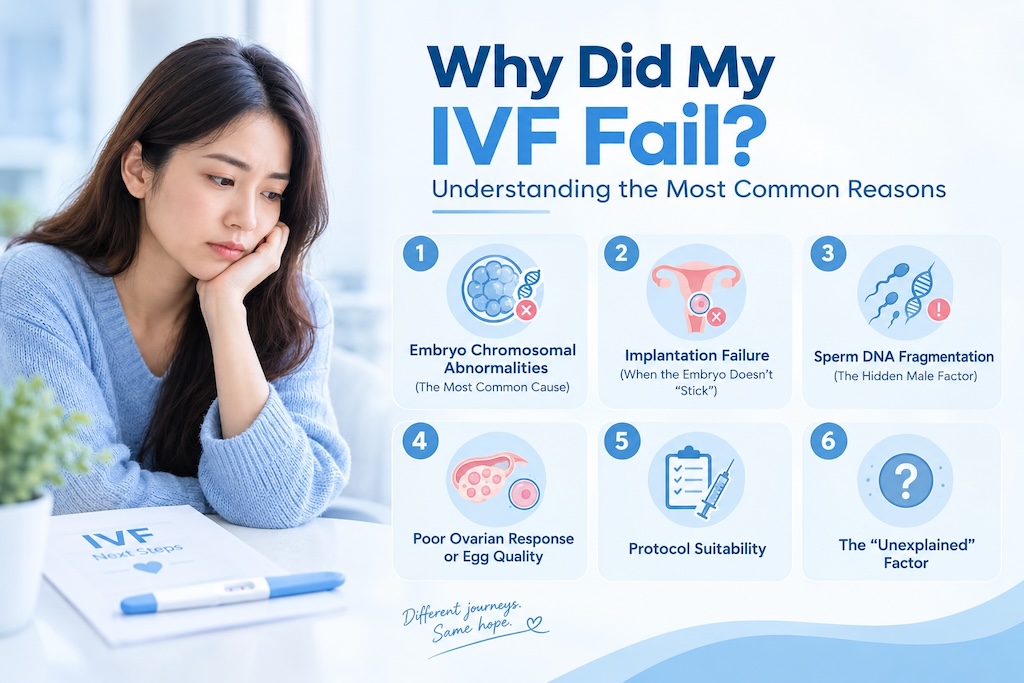
Reason 1: Embryo Chromosomal Abnormalities (The Most Common Cause)
The single most common reason for IVF failure is chromosomal abnormalities within the embryo.
Even embryos that look “perfect” under a microscope can have an incorrect number of chromosomes. These embryos may fail to implant, or if they do implant, they often result in early miscarriage.
What the research shows:
- By age 35-40, over 60% of embryos may have chromosomal abnormalities [1]
- In women aged 38-40, only about 3 out of 10 blastocysts are chromosomally normal [2]
- For women in their mid-40s, over 75% of embryos may be chromosomally abnormal [3]
Why this matters: Chromosomal abnormalities are primarily related to egg quality, which declines with age. This is why maternal age is one of the strongest predictors of IVF success.
How Genesis IVF investigates: We offer PGT-A (Preimplantation Genetic Testing for Aneuploidy) to screen embryos for chromosomal normality before transfer. This helps select the embryo with the best chance of success.
Reason 2: Implantation Failure (When the Embryo Doesn’t “Stick”)
Implantation failure occurs when a transferred embryo fails to attach to the uterine lining. This can happen even with chromosomally normal embryos.
Common implantation-related factors include:
- Endometrial thickness: An optimal lining is generally around 7-10mm. If too thin, implantation may fail.
- Window of Implantation displacement: In some women, the uterus is receptive on a different day than the standard protocol assumes. Studies show 1 in 4 women may have a displaced window.
- Uterine polyps, fibroids, or adhesions: These structural issues can interfere with implantation.
- Chronic endometritis: A silent, low-grade inflammation of the uterine lining that may not cause obvious symptoms.
How Genesis IVF investigates: We offer ERA (Endometrial Receptivity Array) to identify your personal implantation window, hysteroscopy to directly visualize the uterine cavity, and endometrial biopsy to check for infection or inflammation.
Reason 3: Sperm DNA Fragmentation (The Hidden Male Factor)
Standard semen analysis checks count, motility, and morphology—but it does not check the integrity of sperm DNA.
High sperm DNA fragmentation can:
- Allow fertilization to occur but lead to arrested embryo development
- Cause embryos to fail at the blastocyst stage
- Result in implantation failure or early miscarriage
Research shows that high DNA fragmentation is associated with significantly lower implantation rates (51.5% vs. 30.5% in one study). [4]
How Genesis IVF investigates: We offer Sperm DNA Fragmentation testing for male partners, especially when previous cycles failed despite good-quality embryos.
Reason 4: Poor Ovarian Response or Egg Quality
Sometimes, IVF fails because the ovaries didn’t respond as expected to stimulation medication. This can result in:
- Fewer eggs retrieved than anticipated
- Eggs that don’t mature properly
- Eggs that fertilize but don’t develop into viable embryos
Key insight from research: In young women with low ovarian reserve, poor outcomes are primarily driven by limited blastocyst formation rather than impaired implantation capacity. This means the challenge is often producing a transferable embryo, not the uterus rejecting it.
How Genesis IVF investigates: We review your stimulation protocol, consider adjustments for future cycles, and may recommend embryo banking (multiple cycles to collect embryos) if egg numbers are limited.
Reason 5: Protocol Suitability
Every woman responds differently to fertility medications. Sometimes, a failed cycle reveals that the protocol wasn’t optimal for your specific physiology.
Factors that may need adjustment:
- Medication type or dosage
- Trigger shot timing
- Luteal phase support (progesterone type and dosage)
Research suggests that progesterone levels below 10-20 ng/mL at transfer may be associated with poorer outcomes, and alternative progesterone delivery methods may improve results in some cases.
How Genesis IVF investigates: We conduct a comprehensive cycle review, analyzing every data point from your stimulation to transfer, and design a completely new approach if needed.
Reason 6: The “Unexplained” Factor
Sometimes, despite thorough investigation, no clear cause is identified. This is frustrating but important to acknowledge.
What “unexplained” actually means: It often means “not yet fully investigated” or “multifactorial.” Human reproduction is inefficient even under ideal circumstances—on average, only about 25% of transferred embryos successfully implant and result in a live birth. [5]
How Genesis IVF approaches this: We utilize the Alpha IVF Group’s collective experience with complex cases across Malaysia and Singapore. Sometimes success comes from persistence and protocol refinement rather than finding a single “problem.” [6]
What Genesis IVF Does After a Failed Cycle
At Genesis IVF Penang, we don’t just offer another cycle. We conduct a systematic investigation to understand what happened:
Step 1: Comprehensive Review Meeting
- Detailed analysis of your previous cycle
- Review of all laboratory data and embryo development
- Discussion of what went well and what might be improved
Step 2: Targeted Additional Testing
Based on your specific situation:
- Advanced sperm testing (DNA fragmentation) – Based on the doctor’s recommendation
- Genetic carrier screening
Step 3: Protocol Re-design
- A new approach incorporating learnings from your cycle
- Consideration of different medication types or protocols
Common Questions After a Failed IVF Cycle
Q: Was it my fault?
A: No. Implantation failure is not caused by stress, activity, diet, or anything you did wrong. Be kind to yourself.
Q: Should I give up?
A: Absolutely not. Many successful pregnancies occur in second, third, or later cycles. A failed cycle provides valuable information.
Q: How many failed cycles are “too many”?
A: There’s no universal threshold. It depends on your age, diagnosis, and what each cycle revealed. Three or more failed transfers with good-quality embryos warrants a comprehensive workup.
Your Next Step: From “Why” to “What Next”
A failed IVF cycle is not the end of your story—it’s a chapter that provides information for the next one. At Genesis IVF Penang, part of the Alpha IVF Group, we combine advanced diagnostic technology with compassionate care to help you understand what happened and plan a more informed path forward.
Ready to understand why your IVF failed?
Member of Alpha IVF Group – Turning Setbacks into Success Stories Across Asia
Reference
- http://thefertilitysuite.co.uk/wp-content/uploads/2025/06/What-To-Do-When-IVF-Fails.pdf#1#1
- https://fertilitymadrid.com/en/blog/failed-ivf-what-could-be-the-cause-of-an-unsuccessful-cycle-32/
- https://www.advancedfertility.com/blog/ivf-implantation-failure?y_source=1_OTY3MjA5MTgtNTkwLWxvY2F0aW9uLndlYnNpdGU%3D&__cf_chl_tk=FFXQRDrrb.ySkXIMCIWykjh5y3k1ZsfqEHixGCC1l0w-1785791210-1.0.1.1-3vpqFo3DobCAn4RI_yVebA7B4OhRCTrI9PWa4cqKMjk
- https://www.eshre.eu/-/media/sitecore-files/Annual-meeting/ESHRE2021/ABSTRACT-BOOK-FINAL-VERSION_small.pdf?la=en&hash=FA84BD2D8BE4FBBD307456BC8ACFEC2C03E90D60#308#63
- https://www.advancedfertility.com/blog/ivf-implantation-failure?y_source=1_OTY3MjA5MTgtNTkwLWxvY2F0aW9uLndlYnNpdGU%3D&__cf_chl_tk=FFXQRDrrb.ySkXIMCIWykjh5y3k1ZsfqEHixGCC1l0w-1785791210-1.0.1.1-3vpqFo3DobCAn4RI_yVebA7B4OhRCTrI9PWa4cqKMjk
- https://www.genesisivf.com.my/2566/ivf-failed-next-steps-understanding-why/#content