INTRODUCTION
Premature ovarian insufficiency (POI) is characterised by diminished ovarian reserve, poor response to ovarian stimulation, and low chance of spontaneous conception. In vitro activation (IVA) has emerged as a potential treatment option for selected patients with residual ovarian activity.
METHODS
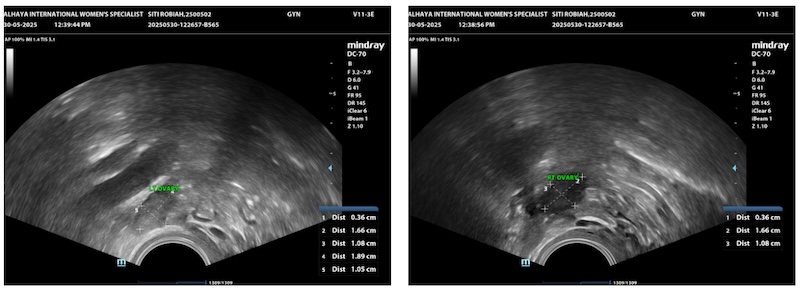
A 32-year-old woman presented in Alhaya with a 4-year history of primary infertility and 1 year amenorrhea. She had severely diminished ovarian reserve, with anti-Müllerian hormone (AMH) <0.07pmol/L, elevated follicle-stimulating hormone (FSH) of 41.2IU/L, and absent antral follicle count (AFC) on ultrasound. She was diagnosed with POI and underwent pre-IVA estrogen optimisation.
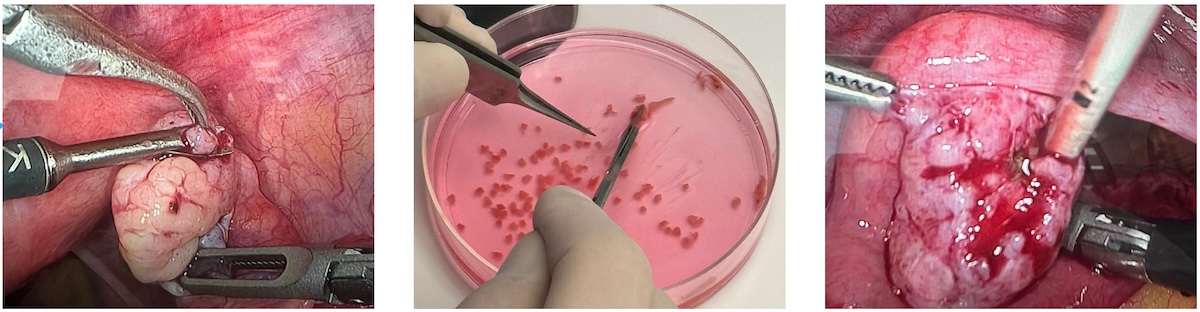
Bilateral IVA surgery was performed in July 2025
RESULTS
Follow-up demonstrated fluctuating hormonal profiles and a single AFC in August 2025. She underwent IVF stimulation; however, despite 16 days of stimulation, there was no follicular growth and IVF was abandoned. After being lost to follow-up, she experienced her first spontaneous natural menses in January 2026 and conceived naturally approximately 7 months after IVA. pregnancy was confirmed at 9 weeks’ gestation (REDD 4.12.2026).
CONCLUSIONS
This case highlights the potential long-term effect of IVA in activating dormant primordial follicles. Because it takes approximately 6 months for follicles to develop from the primordial to the antral stage, patients should be followed-up long-term after IVA. Nevertheless, this case highlights the need to clarify patient selection criteria for spontaneous pregnancy after IVA surgery.
By
Wan Syahirah Yang Mohsin; Gan Shu Kee; Lee Soon Soo, Colin; Kazuhiro Kawamura
Alhaya International Women’s Specialists Sdn. Bhd.
NO. 3.01, Left Wing, Level 3, Damansara Specialist Hospital, 2, Jalan Bukit Lanjan 3, Bukit Lanjan, 60000 Kuala Lumpur, Federal Territory of Kuala Lumpur
BIBLIOGRAPHY
Tanaka Y, Hsueh AJ, Kawamura K. Surgical approaches of drug-free in vitro activation and laparoscopic ovarian incision to treat patients with ovarian infertility. Fertility and Sterility. 2020 December;114(6):1355.
Kawamura K, Cheng Y, Suzuki N, Deguchi M, Sato Y, Takae S, Ho C, Kawamura N, Tamura M, Hashimoto S, Sugishita Y, Morimoto Y, Hosoi Y, Yoshioka N, Ishizuka B, Hsueh AJ. Hippo signaling disruption and Akt stimulation of
ovarian follicles for infertility treatment. PNAS. 2013 October;110(43):17474-17479.
Ghezelayagh Z, Khoshdel-Rad N, Ebrahimi B. Human ovarian tissue in-vitro culture: primordial follicle activation as a new strategy for female fertility preservation. Cytotechnology. 2022 January;74:1-15.
Zhai J, Yao G, Dong F, Bu Z, Cheng Y, Sato Y, Hu L, Zhang Y, Wang J, Dai S, Li J, Sun J, Hsueh AJ, Kawamura K, Sun Y. In vitro activation of follicles and fresh tissue auto-transplantation in primary ovarian insufficiency patients.
J Clin Endocrinol Metab. 2016 November;101(11):4405-4412.
Vo KCT, Kawamura K. Ovarian fragmentation and AKT stimulation for expansion of fertile lifespan. Frontiers in Reproductive Health. 2021 March;3:1-10.
Kawashima I, Kawamura K. Regulation of follicle growth through hormonal factors and mechanical cues mediated by Hippo signaling pathway. Systems Biology in Reproductive Medicine. 2018;64(1):3-11.
Suzuki N, Yoshioka N, Takae S, Sugishita Y, Tamura M, Hashimoto S, Morimoto Y, Kawamura K. Successful fertility preservation following ovarian tissue vitrification in patients with primary ovarian insufficiency. Human
Reproduction. 2015 January;30(3):608-615.
Kawamura K, Cheng Y, Sun Y, Zhai J, Diaz-Garcia C, Simon C, Pellicer A, Hsueh AJ. Ovary transplantation: to activate or not to activate. Human Reproduction. 2015 September;30(11):2457-2460.